
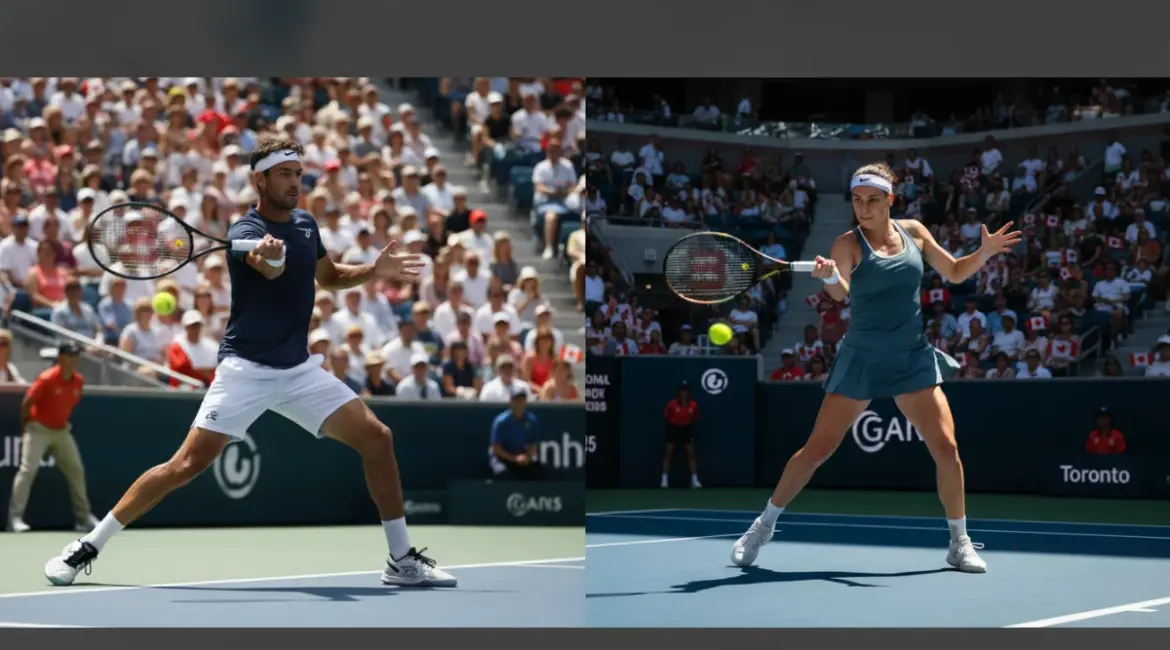
The National Bank Open reaches a crucial stretch this weekend as the men in Montreal and the women in Toronto fight for quarterfinal spots. The round of 16 should separate the true contenders from the surprise survivors.
Saturday, August 8, and Sunday, August 9, will settle the next stage of both draws. By the end of play, only eight men and eight women will still be alive in the tournament.
What the Schedule Looks Like
The round of 16 is split across two days in both cities, with action centered on the main courts and timing shaped by match length and conditions. Montreal uses IGA Stadium as its main stage, while Toronto serves as the women’s hub.
- Montreal day sessions begin at 12:30 p.m., with evening sessions starting at 6 p.m.
- Toronto day sessions begin at 12:30 p.m., with evening sessions starting at 7 p.m.
- Each city will stage eight singles matches over the weekend.
- The winners move on to the quarterfinals on Monday, August 10, and Tuesday, August 11.
The official order of play is usually released the day before each session, since match time and weather can force adjustments.
Montreal Has Turned into an Open Field
The men’s draw has already lost several of its biggest names. Alexander Zverev, Daniil Medvedev, Taylor Fritz, and Andrey Rublev were all beaten early, and Félix Auger-Aliassime withdrew with a back injury before playing his opening match.
That left the section of the draw far less predictable than expected. Six of the top 10 seeds were gone before the second round ended, which gives the remaining players a real chance to push deep into the event.
Ben Shelton stands out as one of the main threats. The defending champion opened with a straight-sets win over Jenson Brooksby and brings a serve-and-attack style that suits Montreal’s fast conditions.
Casper Ruud also deserves attention after a dominant first-round win over Juan Manuel Cerúndolo. While clay remains his best surface, he has enough hard-court experience to take advantage of the opportunities in front of him.
Why Shelton Still Has a Real Chance
Shelton arrives in Montreal carrying the pressure that comes with being the defending champion. His 2025 title was his first Masters 1000 crown, and it came through a mix of power, confidence, and big serving.
This year’s task is different. He is no longer the underdog in the conversation, and the path to the final looks more manageable after several top seeds were removed.
That said, Shelton still has to manage his own volatility. When he rushes points or tries to end rallies too quickly, he can create problems for himself. If he stays disciplined, he remains one of the strongest bets in the men’s bracket.
Young Players Are Taking Their Opening
The early upsets have given younger players room to matter. João Fonseca delivered one of the sharpest results of the first rounds by beating Stefanos Tsitsipas in a high-level match.
The Brazilian already plays with the pace and confidence of a top prospect, and the Montreal crowd has quickly had a reason to notice him.
Arthur Fils is another player with a clear path to the later rounds. He got past Zachary Svajda in three sets and has the movement and aggression needed to handle this court.
Tallon Griekspoor also enters the round of 16 with momentum after his comeback win over Zverev. He lost the first set, then turned the match around with a 6-7, 6-2, 6-4 victory that may prove more valuable than it first appeared.
Canada’s Men Are Out, but the Crowd Still Has Reasons to Watch
Canadian hopes in the men’s draw were damaged quickly. Auger-Aliassime never reached the court because of his injury, and Gabriel Diallo’s run ended after he retired against Luciano Darderi while trailing in the second round.
That means no Canadian man made the round of 16, which is a major disappointment for the home supporters in Montreal.
Even so, the field still includes several players likely to draw attention, especially Shelton, Ruud, Fonseca, Fils, and Griekspoor. Those names give the men’s side plenty of intrigue heading into the weekend.
Toronto’s Top Women Are Largely on Track
The women’s draw has been much steadier. Aryna Sabalenka, Elena Rybakina, Jessica Pegula, Coco Gauff, and Mirra Andreeva all advanced through their first matches, keeping the top of the bracket intact.
Sabalenka remains the main target. She started with a straight-sets win over Moyuka Uchijima and extended her hard-court winning streak to 13 matches. Her power and serve fit Toronto’s pace very well.
Rybakina also remains in the title picture, though her level has not been as clean. She needed three sets to get past Daria Kasatkina, finishing with an unusually high number of errors alongside her usual power.
The Main Threats in the Women’s Draw
Rybakina’s ceiling remains extremely high. When her first serve lands and her timing is sharp, very few players can live with her. The concern is whether she can keep the mistakes under control against stronger opposition.
She can still move into the top ranking conversation, but that would require winning the title and having Sabalenka exit before the round of 16.
Gauff and Pegula also remain dangerous. Gauff handled Kayla Day in straight sets, using speed and defense to manage the key moments.
Pegula had to work harder after dropping the first set against Magdalena Frech, but she finished strongly and won eight of the final nine games. Her record in Canada makes her especially dangerous in this event.
Andreeva may have produced the cleanest win of the group. She dismissed Karolina Pliskova 6-0, 6-2 in just 54 minutes and showed the maturity that has made her one of the tour’s most interesting young players.
Fernandez Keeps Canada in the Conversation
Leylah Fernandez is the last Canadian left in either singles draw. She beat Renata Zarazúa 6-2, 6-2 in front of the home crowd and kept the Canadian presence alive for at least one more round.
Her next test is Elise Mertens, a solid, experienced opponent who can make matches uncomfortable by extending rallies and changing rhythm.
Fernandez will need to stay aggressive. When she attacks early and uses her forehand to open the court, she can challenge the best players in the field.
The pressure is real, though, because she was already Canada’s final singles hope before her opening match even began.
How to Follow the Tournament
Sportsnet and TVA Sports are the official Canadian broadcasters for the National Bank Open. Both networks are carrying coverage from Montreal and Toronto throughout the event, with additional streaming available through their digital platforms.
Because schedules can shift, fans should check the order of play before each session starts. Match lengths and weather can change the timing quickly.
What This Weekend Will Reveal
The round of 16 should clarify which players are truly positioned to win the title. In Montreal, the bracket has opened enough to make almost any deep run possible, but Shelton, Ruud, Fonseca, Fils, and Griekspoor all have a real shot.
In Toronto, the women’s title picture still runs through Sabalenka, Rybakina, Pegula, Gauff, and Andreeva. Any of them could leave the weekend looking like the favorite.
For Canadian fans, Fernandez is the name that matters most. If she advances, local interest stays alive. If she falls, the weekend will belong entirely to the international stars chasing the final eight.