
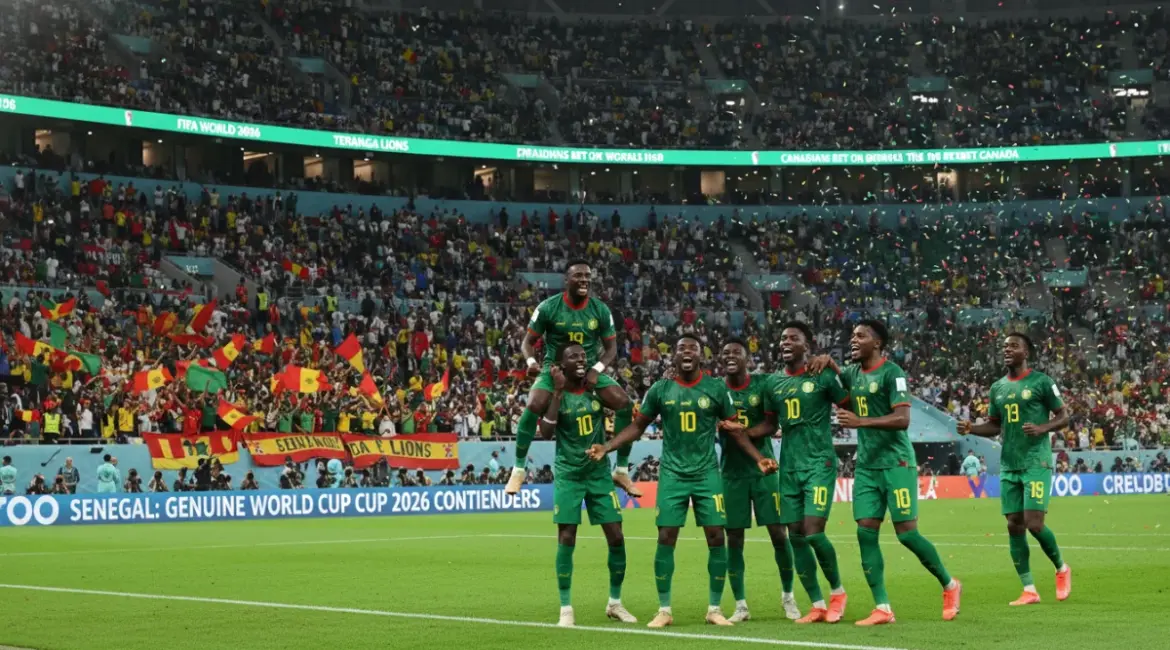
Senegal enters the 2026 FIFA World Cup conversation with real ambition, not polite optimism. Head coach Pape Thiaw captured that shift clearly when he said he would step aside if he ever doubted he could win the tournament with Senegal.
That kind of statement would once have sounded unrealistic, but Senegal now carries the profile of a genuine contender from Africa. The squad blends proven veterans, fast-rising prospects, and a system that has made the nation one of the most productive talent factories in world football. For fans tracking tournament value, the Senegal World Cup 2026 prospects remain among the most compelling in the field, and Canadians can bet on Senegal for the World Cup on Rexbet Canada.

But the same system that fuels Senegal’s rise also raises difficult questions. The national team benefits from an efficient pipeline, yet the local game often absorbs the costs. That tension sits at the center of Senegal’s football story: elite success on the surface, structural strain underneath.
How Senegal Keeps Producing Elite Players
Senegal’s talent output is remarkable for a country of roughly 20 million people. The engine behind that success is a network of high-level academies such as Generation Foot, Diambars, and Dakar Sacre Coeur, which combine football training with schooling and medical support.
These academies regularly move teenagers into Europe before they reach full professional maturity. Their graduates have entered top leagues with uncommon consistency, which is part of why Senegal has become one of the continent’s most respected footballing nations.
- They identify players early and provide structured development.
- They offer education and health support alongside football training.
- They maintain strong pathways into elite European clubs.
- They have helped Senegal build a national team with depth and balance.
The problem is not the quality of the model. The problem is who captures the value when that model succeeds.
The Money Often Leaves Before It Returns
Much of the business behind Senegalese player development is built on long-term partnerships with European clubs. FC Metz, for example, has spent more than two decades backing Generation Foot and securing first refusal on its top prospects. That relationship helped produce stars such as Sadio Mane, Ismaila Sarr, and Pape Matar Sarr.
Yet the financial return to Senegal’s academies is tiny compared with the wealth generated later in Europe. One review of 13 academy-trained players selected for Senegal’s continental squads found that the academies received only €100,000 in initial transfer fees, while the European clubs involved later sold those same players for a combined €81.2 million. Across their careers, those 13 players produced more than €411 million in transfer fees.
That imbalance explains why Senegal’s domestic football economy still struggles. Local clubs often face poor infrastructure, limited stadium quality, and low visibility, even while their graduates succeed abroad.
Administrative problems have made matters worse. In some cases, clubs have even had to push the federation to recover solidarity payments owed under FIFA rules from major transfers, including Nicolas Jackson’s €37 million move to Chelsea. The system rewards Senegal’s talent export, but not always the places where that talent was first developed.
A Squad Built for the Biggest Stage
Senegal’s rise is not only about youth academies. The federation has also become highly effective at recruiting diaspora players before other countries lock them in. That approach has helped Senegal compete for dual-national talents who might once have chosen European powerhouses.
Recent examples include Paris Saint-Germain forward Ibrahim Mbaye and Chelsea defender Mamadou Sarr, both of whom represented France at youth level before aligning with Senegal. The strategy is simple but effective: combine family identity, national pride, and the chance to join a winning project.
- Veterans bring leadership and tournament experience.
- Academy graduates add pace, technical quality, and familiarity with the system.
- Diaspora recruits deepen the pool and raise the ceiling.
- The result is a squad with unusual age range and tactical flexibility.
That mix allows players like 36-year-old Idrissa Gana Gueye to share the field with teenagers who already belong at the highest level.
What 2026 Could Mean for Senegal
The 2026 tournament may be the final major World Cup chance for Senegal’s golden generation. Sadio Mane, Kalidou Koulibaly, and Edouard Mendy have already defined an era, and this competition in North America could be their last opportunity to leave a lasting imprint on the world stage.
The group draw is demanding. Senegal has landed alongside France, Norway, and Iraq in Group I, which means there is little room for a slow start. The opening match against France in New Jersey will test Senegal’s mentality as much as its quality.
If Senegal advances, its profile becomes dangerous very quickly. The team has the physical power, defensive structure, and depth needed to trouble opponents in knockout football. That said, the bigger story is not only what Senegal can do in 2026, but what its success reveals about the cost of building a world-class team when the domestic system still needs serious repair.