
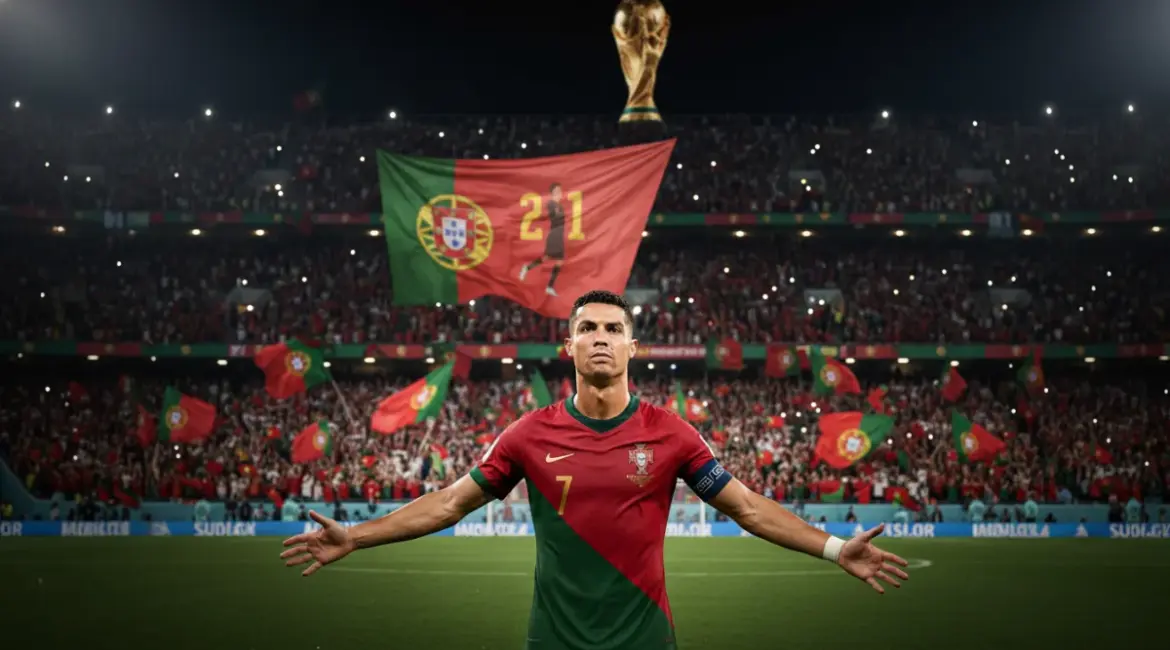
Portugal’s latest World Cup squad announcement has drawn attention for two reasons: Cristiano Ronaldo is back for another historic chase, and the memory of Diogo Jota remains deeply woven into the team’s story. Roberto Martínez has named a group that mixes veteran control, speed on the wings, and serious depth in every line.
For Portugal, this is not just another tournament roster. It is a statement of ambition. With Ronaldo still central to the attack and a talented core behind him, the team enters the competition believing it can challenge the best nations in the field.
Ronaldo’s Sixth Tournament Chase
Cristiano Ronaldo remains the most recognizable name in the squad, and his selection gives Portugal an immediate headline. At 41, he is preparing for what could be a sixth FIFA World Cup appearance, a milestone that would place him among the most enduring figures in the history of the men’s game.
Ronaldo’s legacy already includes a remarkable list of achievements:
- Most goals in men’s international football
- Most appearances in men’s international football
- Only male player to score in five separate World Cups
- One of the most influential captains Portugal has ever produced
Martínez’s decision is about more than fame or nostalgia. Ronaldo still brings leadership, pressure handling, and a proven ability to decide matches when moments become tense. Even with younger attacking options available, Portugal clearly believes his presence matters.
Diogo Jota’s Absence Shapes the Mood
The emotional center of the announcement was the tribute to Diogo Jota. The former Liverpool and Portugal forward died in a car crash in Spain last year at the age of 28, leaving a painful gap in both club and country football.
Martínez referred to Jota as Portugal’s “plus one forever,” a phrase that turned the squad reveal into more than a football story. It became a reminder that some players remain part of a team’s identity long after their final match.
That sentiment could matter throughout the tournament. In a squad built around pressure and expectation, Jota’s memory gives Portugal an added emotional layer and a clear source of unity.
The Squad: Balance, Flexibility, and Depth
Portugal’s roster looks well built from back to front. Martínez has selected players who can defend, control possession, and attack in different ways depending on the opponent. That flexibility may be one of the team’s biggest strengths.
| Area | Key Names | Main Strength |
|---|---|---|
| Goalkeepers | Diogo Costa, José Sá, Rui Silva, Ricardo Velho | Reliable depth and shot-stopping security |
| Defenders | Rúben Dias, João Cancelo, Diogo Dalot, Nuno Mendes | Strong structure with attacking full-back support |
| Midfielders | Bruno Fernandes, Bernardo Silva, Vitinha, João Neves | Creativity, control, and ball progression |
| Forwards | Ronaldo, Rafael Leão, João Félix, Gonçalo Ramos | Variety, pace, and finishing power |
The goalkeeper group is straightforward, with Diogo Costa expected to remain the first choice. Ricardo Velho’s inclusion as a fourth option is mostly insurance, but it also underlines how carefully Portugal has planned for depth.
At the back, Rúben Dias should anchor the defense, while João Cancelo, Diogo Dalot, and Nuno Mendes offer a more aggressive edge from wide areas. This is a defense that can protect a lead without becoming passive.
In midfield, Portugal has a mix many teams would envy. Bruno Fernandes and Bernardo Silva provide vision and experience, while Vitinha and João Neves bring energy, composure, and technical sharpness. Rúben Neves and Samú Costa add more control and balance when needed.
Up front, the options are equally varied:
- Cristiano Ronaldo as the finishing focal point
- Rafael Leão for direct running and acceleration
- João Félix for movement between the lines
- Gonçalo Ramos as a central striker option
- Pedro Neto and Francisco Conceição for width and pace
- Francisco Trincão and Gonçalo Guedes as extra attacking alternatives
Group Stage Path and Preparation Plans
Portugal has been placed in Group K alongside Congo, Uzbekistan, and Colombia. That mix should give Martínez different types of problems to solve, from compact defending to athletic midfield pressure.
The team’s schedule is already set in motion:
- Portugal vs. Chile — June 6
- Portugal vs. Nigeria — June 10
- Travel to the United States — June 12
- Portugal vs. Congo — June 17
Portugal will open the tournament against Congo in Houston on June 17. The squad is expected to gather for preparation on June 1, giving Martínez time to test combinations and settle on a starting group before the real pressure begins.
Why Portugal Has Real Contender Status
Martínez has stopped short of calling Portugal the outright favorite, but he has made it clear that the team belongs in the discussion. That approach feels sensible. Portugal has not yet won a World Cup, but recent results suggest the talent level is strong enough to dream big.
The team’s 2025 Nations League title, earned through wins over Germany in the semifinal and Spain in the final, showed that Portugal can handle elite opposition in high-stakes matches. That experience matters in a tournament where margins are thin.
A few factors stand out:
- A deep squad with options at nearly every position
- Proven leadership from Ronaldo
- Creative control from Bruno Fernandes, Bernardo Silva, and Vitinha
- Dangerous pace from Rafael Leão and Pedro Neto
- High-level defensive talent led by Rúben Dias
- Extra motivation from Jota’s memory
If Portugal finds the right rhythm quickly, it can be a difficult team to manage. The ceiling is high because the squad is not built around one style alone; it can adapt, press, wait, or attack in waves.
A Team Carrying History, Pressure, and Purpose
Ronaldo’s possible final World Cup chapter gives the tournament a sense of finality and scale. A title would complete a legacy already filled with records, trophies, and years of excellence at the highest level.
For Portugal, the goal is even larger. This generation has the talent to become the first in the nation’s history to lift the World Cup. That kind of opportunity does not come often.
And for everyone inside the squad, Diogo Jota’s memory adds something that cannot be measured in tactics or statistics. Portugal enters the tournament with quality, belief, and emotional force, which is often the combination that separates good teams from truly dangerous ones.