
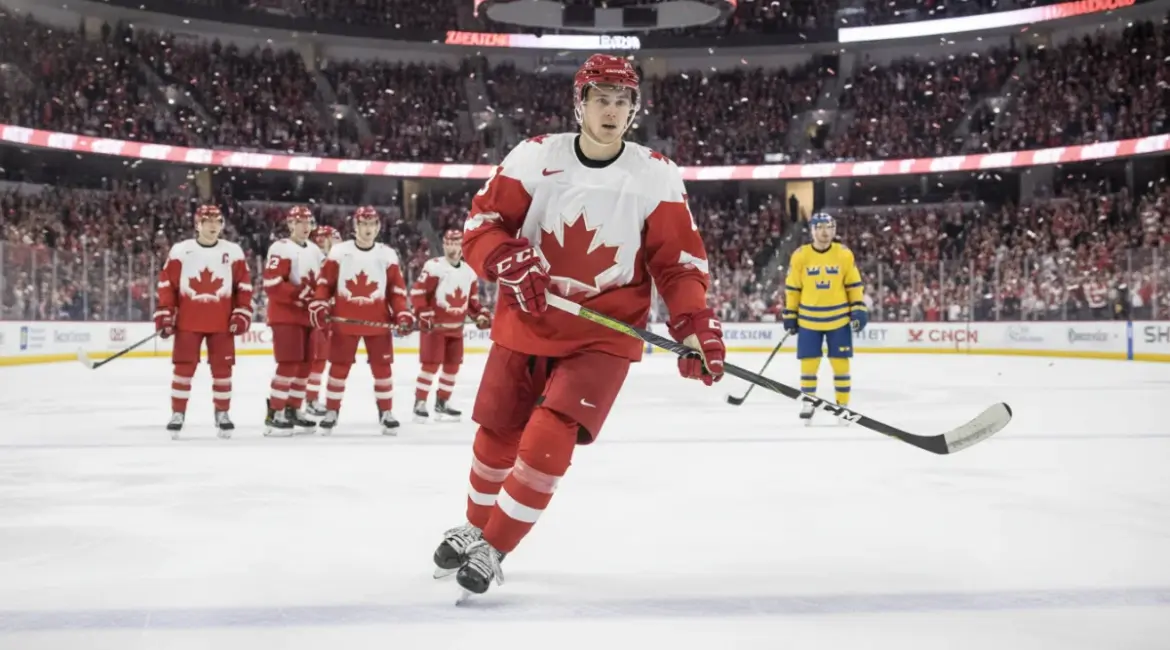
Canada has already locked up a semifinal berth at the Hlinka Gretzky Cup, but the most important games are still coming. After a fast start in Edmonton, the team now shifts from securing advancement to sharpening details for the medal round.
Canada finished its first two Group A games with convincing wins over Switzerland and Slovakia, which secured first place before the final preliminary matchup against Sweden. That game is set for Wednesday, August 5, at Rogers Place, with puck drop scheduled for 5 p.m. Mountain Time and 7 p.m. Eastern Time.
The standings have eased some of the immediate pressure, but the meeting with Sweden still matters. It is the last chance to settle line combinations, test special teams, and measure Canada’s form against a team that still has something to prove.
A Strong Opening Has Set the Tone
Canada’s tournament began with a 7-3 win over Switzerland, a game that showed just how quickly the offense can overwhelm an opponent. Canada scored five times in the opening period and finished with a 48-25 shot edge, which reflected how much time it spent dictating play in the attacking zone.
Liam Pue scored twice in that opener, and Brock England, Camryn Warren, Ryerson Edgar, and Benjamin Veitch also found the net. England later added a shorthanded goal in the third period, giving him a two-goal performance and adding another highlight to Canada’s depth-driven attack.
The second game was even more one-sided. Canada defeated Slovakia 6-1 and controlled the pace almost from the opening faceoff.
- Kayden Stroeder scored two goals.
- Landon DuPont, Warren, Edgar, and Pue also scored.
- Canada fired 48 shots on goal.
- Goaltender Leif Oaten stopped 12 of 13 shots.
Through two games, the scoring has been spread across the roster rather than concentrated in one place. Pue, Edgar, and Warren each had four points, while Maddox Schultz led the club with four assists. That balance makes Canada harder to defend because opponents cannot focus on only one line or one centerpiece.
That kind of distribution can matter even more in a short tournament. In a single-elimination setting, teams need production from multiple sources because one quiet period can end the event.
What Sweden Brings to the Final Group Game
Sweden enters the matchup with real motivation. The Swedes opened with a 4-3 victory over Slovakia before dropping a 7-6 shootout-like track meet against Switzerland, leaving their semifinal hopes tied to the final group-stage result.
Unlike Canada, Sweden cannot afford to coast. A strong performance against the Canadians would help stabilize its position and keep its path to the semifinals alive.
Canada already beat Sweden 3-1 in a pre-tournament meeting, but that result only tells part of the story. Group play brings a different level of urgency, and Sweden’s attack has already shown it can create problems.
| Team | Record After Two Games | Key Offensive Note |
|---|---|---|
| Canada | 2-0 | Multiple scorers and dominant shot totals |
| Sweden | 1-1 | Strong scoring output but inconsistent results |
Sweden has also put up notable individual production. Dorian Eklund Aspe had four points entering the game, while Oliver Sundberg and Milan Sundstrom each scored twice through their first two appearances. That kind of scoring touch means Canada cannot treat the final preliminary game as a formality.
For Canada, the value of the game is less about qualification and more about preparation. Head coach Ryan Oulahen can use the matchup to evaluate pairings, manage ice time, and make sure his group is ready for the faster tempo that usually appears once medals are on the line. Oulahen was part of Canada’s staff during the 2024 title run in Edmonton and now leads the team as head coach.
The Semifinal Picture Is Still Taking Shape
Canada’s first-place finish in Group A means its semifinal opponent will be the second-place team from Group B. That matchup will not be finalized until the rest of the preliminary round is completed.
At this stage, the United States was leading Group B after two games, with Czechia and Finland tied behind them on three points each. Germany had yet to earn a point, so the bracket remained unsettled heading into the final round of group play.
The format is straightforward: the Group A winner plays the Group B runner-up, and the Group B winner meets the second-place team from Group A. The semifinal winners move on to Saturday’s gold-medal game, while the losers will play for bronze.
That structure makes every late-stage detail important. Even with a strong group record, Canada still has to prove it can handle the sharp increase in pressure that comes with knockout hockey.
The Canadians learned that lesson last year. They went unbeaten in the preliminary round of the 2025 tournament, then lost 4-3 to the United States in a semifinal shootout before rebounding to defeat Finland for bronze. It was a reminder that momentum in group play does not guarantee success once the field narrows.
Why This Tournament Carries Extra Weight for Canada
Canada’s history at the Hlinka Gretzky Cup has created a standard that is difficult to match. The country has won 25 of the 34 summer under-18 gold medals awarded since the event began in 1991, including long title runs from 1996 to 2002 and from 2008 to 2015.
The stakes rise again when the event is held in Alberta. Before this year, Canada had already won every previous Alberta-hosted edition: Edmonton and Red Deer in 2018, Red Deer in 2022, and Edmonton in 2024. Canada beat Czechia 2-1 in the gold-medal game at Rogers Place in 2024.
That history adds pressure, but it also adds expectation. A championship this week would preserve the program’s perfect Alberta record and deliver a 26th summer under-18 title.
The event also serves as an early look at future draft talent, which gives the medal round an added layer of interest. The Hlinka Gretzky Cup routinely features some of the top under-18 players from eight major hockey nations, and it arrives before many club or school conflicts can affect roster strength.
For Canada, that means the spotlight is not only on the team’s result. It is also on players who could soon become familiar names in the Canadian Hockey League and at the NHL draft level. DuPont has drawn plenty of attention, but Pue, Edgar, Warren, Schultz, and Stroeder have all made strong early impressions as well.
The medal round will now show whether those players can carry their form into elimination hockey, where every shift carries more weight and the margin for error drops fast.
Canada has already done the hard part of the opening phase. The next step is turning that momentum into two more wins and a chance to play for gold on home ice.